How Do I Test If My Tap Water Is Bad in Deer Park?
Most tap water problems give small hints first, and the right test tells you which hints actually matter in your home.
How do I test if my tap water is bad?
Start by paying attention to taste, smell, color and stains, then read your water utility's annual quality report. Home test strips give a quick look at chlorine, hardness and pH, but lead, bacteria and many other contaminants need a certified lab. If something seems off, an in-home test finds the cause before you buy anything.
What are the signs your tap water might have a problem?
Your senses are a decent first screen. They can't catch everything, but they often point to where the trouble starts. Write down what you notice and where, because a problem at one faucet tells a different story than a problem at every tap in your home.
A few common signs and what they usually mean:
- A pool or bleach smell, often the disinfectant the utility adds, which is a taste issue more than a safety one
- A rotten egg smell, sometimes from the water heater and sometimes from the water itself
- Rust-colored water or orange stains, which can come from iron or from aging galvanized pipes
- White crust on faucets, shower glass and the coffee maker, a sign of hard water minerals
- Cloudy water that clears from the bottom up, usually just tiny air bubbles and nothing to worry about
- A metallic taste, which can point to corroding plumbing and is worth a lab test for lead or copper
Start with your water utility's annual quality report
If you are on city water, your utility is required to publish a yearly water quality report. It lists what was tested, what was found and how the results compare to federal limits. It is free, it is the most complete picture of the water leaving the treatment plant, and it is a good place to begin.
The catch is that the report stops at the street. It can't tell you what happens inside your home's pipes, water heater or fixtures. Older plumbing, a corroded fitting or a long-unused bathroom line can change the water between the meter and your glass. That is why the report and a test at your own tap answer two different questions.
Can home test kits tell you if your water is safe?
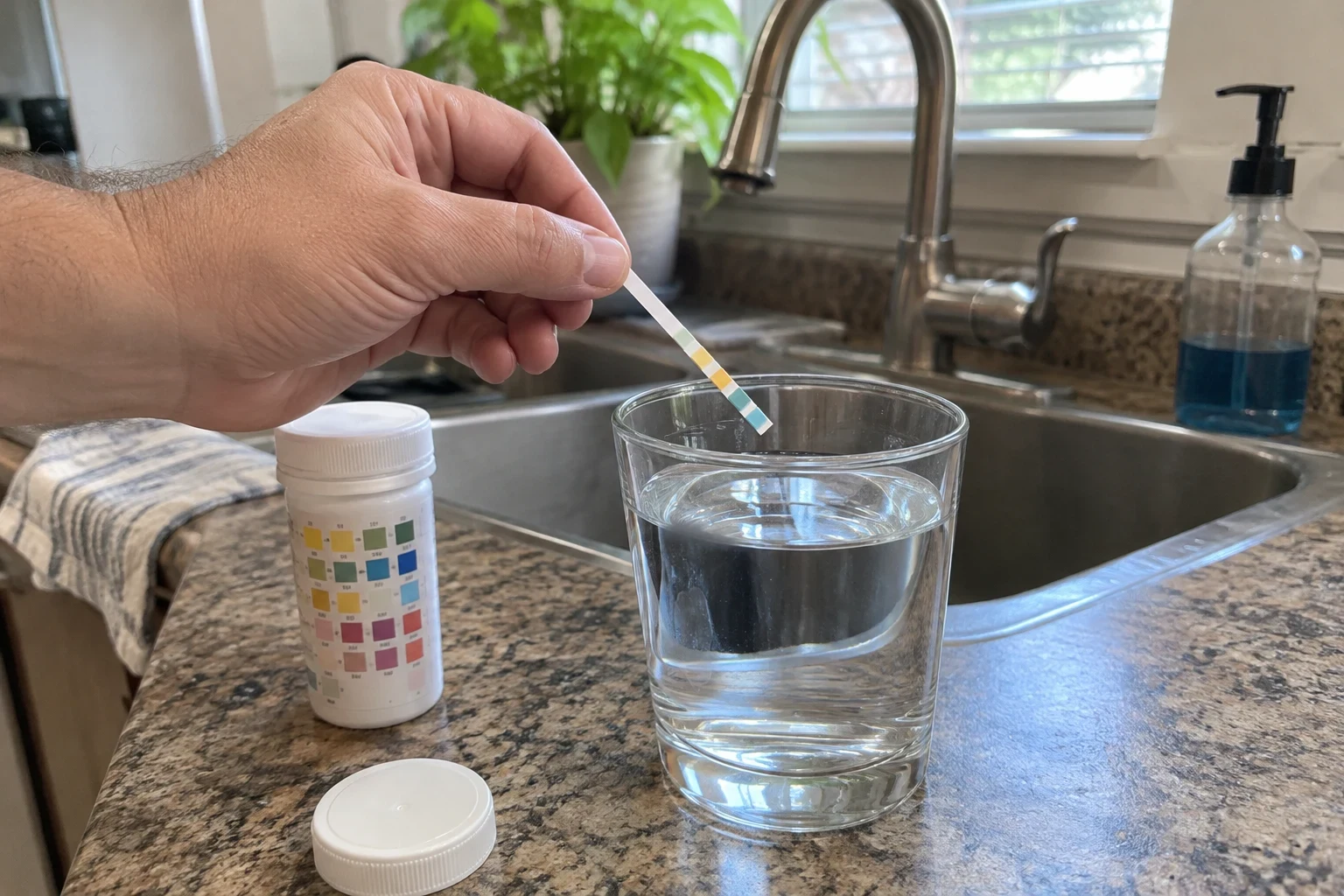
Home test strips are cheap and quick. Dip a strip, wait, and match the colors to a chart. They work reasonably well for chlorine, hardness, pH and sometimes iron, which makes them handy for figuring out whether a taste or scale problem is worth chasing.
They are not built to answer the safety question. Strips are hard to read precisely, color matching varies with your kitchen lighting, and many kits can't detect lead at the low levels that matter. A strip that comes back clean does not mean your water is free of bacteria, lead or other trace contaminants. Treat a home kit as a first look, not a verdict.
When should you use a certified lab test instead?
A certified lab uses calibrated equipment and a set sampling method, so the numbers hold up. It costs more time than a strip, but it is the right call when health is the real question. Follow the lab's instructions closely, especially for lead, where the first water out of the tap after sitting overnight is the sample that counts.
Here is when a lab test is worth it:
- Your home has older plumbing, galvanized pipes or you are not sure what is in the walls
- Someone in the house is pregnant, or you are mixing baby formula with tap water
- You rely on a private well, which no utility tests for you
- Your area flooded or your well head was underwater after a Gulf storm
- A home kit or your senses flagged something you can't explain
- You are about to buy a treatment system and want to know exactly what it needs to handle
What an in-home water test from us looks like
We start by listening. You tell us what you have noticed, which taps it happens at and how long it has been going on. Then we look at your plumbing, your water heater and any equipment you already have, and we test the water right at your tap so you can see the results as we read them.
Next we explain what we found in plain terms: what is normal, what is a comfort issue like chlorine taste, and what deserves a closer look. If something needs a certified lab to confirm it, we say so instead of guessing. Plenty of Deer Park homeowners learn their water is fine and the fix is a simple one, and that is a perfectly good result.
If treatment does make sense, we match it to what the test showed. That might be a reverse osmosis unit for drinking water, whole-home filtration for taste and odor, or well water treatment for a private well. We offer free installation and full services after the sale, so you are not left on your own once the system is running.
More questions about testing tap water
How often should I test my well water?
Test a private well at least once a year for bacteria and nitrates, and again any time the taste, smell or color changes. Test right away after flooding or any work on the well.
Does boiling make bad tap water safe?
Boiling kills bacteria, which is why utilities issue boil notices. It does not remove lead or minerals and can actually concentrate them as water evaporates.
My water passed the city report. Do I still need to test?
Not always. If you have newer plumbing and no taste, smell or staining issues, you may be fine. Testing at your tap makes sense when your home is older or something about the water bothers you.
Is cloudy tap water dangerous?
Cloudiness that clears from the bottom of the glass up in a minute or so is just air. Cloudiness that stays or leaves sediment is worth testing.
Want a clear answer about your water?
Tell us what you are seeing, smelling or tasting, and we will explain which test fits your situation and set up a time to test the water at your home. You get plain findings first and a recommendation only if your water needs one.